
Introduction
Cash flow and accounting management are major challenges for any association, whatever its size. When handled well, they ensure transparency for members, authorities and funders, and contribute to the organisation’s long-term stability. Poor organisation, however, can weaken the association and damage its credibility.
This guide aims to:
- clearly explain the various legal obligations in Switzerland, particularly in the canton of Geneva;
- present the three possible accounting systems and their implications;
- propose simple methods for implementing appropriate management practices.
This guide is intended primarily for associations operating in Switzerland, and more specifically those based in the canton of Geneva, given the city’s particular requirements for awarding subsidies. It is aimed at volunteers or employees responsible for managing finances, committee members, and anyone wishing to understand the basics of financial management within an association.
For all questions relating to association taxation, including taxes, exemptions, VAT and more, please refer to our dedicated guide.
1. Cash flow versus accounting
Cash flow is one of the essential elements of managing an association, both at the moment of its creation and throughout its activities.
It refers to all immediately available funds – the money the association can access at any time to cover its current expenses. Cash flow is vital for ensuring the smooth day-to-day running of the association, anticipating financial difficulties, making informed strategic decisions, and reassuring partners, members and potential funders. It reflects the association’s ability to meet its short-term financial commitments (such as rent, salaries, etc.) and should be regarded as a key indicator of its financial health and long-term viability.
Cash flow generally covers two aspects:
- Cash flow management in the strict sense refers to the monitoring and planning of short-term financial movements – cash held in the bank or on hand, incoming payments, outgoing expenses, donations, and so on. In short, it involves keeping track of all the association’s cash inflows and outflows.
- Accounting represents the administrative and regulatory side of financial management: recording and processing financial transactions, preparing financial statements, and managing all related documents.
In this guide, we present the three possible types of accounting:
Cash accounting, or income and expenditure accounting: the simplest form of bookkeeping
- Commercial accounting: ‘standard’ accounting according to the Swiss Code of Obligations (CO)
- Accounting in accordance with a recognised standard: Swiss GAAP FER (RPC) within the framework of an association domiciled in Switzerland
- The larger an association becomes, the more comprehensive (and therefore more complex!) its accounting will need to be. The next section of this guide will help you determine which accounting regime applies to your organisation.
Cash management and accounting can be carried out by the same person within an association. In small associations using cash accounting, the treasurer often acts as both an accountant and cash manager, and frequently holds a position on the association’s governing body. For commercial accounting or accounting in line with recognised standards, however, it is recommended to separate these two roles. This helps to distribute the workload and provides an additional layer of oversight.
| Type of accounting | Role of the treasurer | Role of the person who prepares the accounts |
|---|---|---|
| Cash accounting | Monitors income/expenditure flows, presents the financial report to the general meeting, ensures compliance with minimum legal requirements. | Records income and expenditure, updates the cash flow statement, maintains the statement of assets and liabilities |
| Commercial accounting (CO) | Ensures that all accounting entries are correctly recorded and properly filed, checks the year-end closures, and prepares the balance sheet and income statement in compliance with the Swiss Code of Obligations (CO). | Performs accounting entries, prepares financial statements, reconciles bank accounts and receivables/payables. |
| Accounting in accordance with recognised standards (e.g. Swiss GAAP FER) | Ensures compliance with selected standards, guarantees transparency towards members and funders, coordinates with the external auditor if mandatory review is required. | Applies the rules of the standard (presentation, valuations), prepares the required appendices and reports, manages complex entries (depreciation, provisions). |
Unless otherwise specified in the articles of association, the treasurer primarily has an executive role – they provide information and advice to the association regarding its assets and finances and work to implement the association’s decisions. At the same time, by maintaining an objective overview of the finances, they make recommendations on spending, reimbursements, investments, and savings in a way that aligns with the association’s long-term goals.
The articles of association may specify several aspects relating to cash flow, in particular:
- The association’s legal authorisation procedures specify who is entitled to sign contracts or pay invoices on behalf of the association. They also indicate whether such decisions can be made individually or must be authorised by multiple committee members. It is possible to set a maximum amount that one person can approve alone. Above that limit, a collective signature from several members is usually required.
- The terms of the financial year (start and end dates, duration, and whether it aligns with the calendar year).
- The obligation to report to a supervisory body or the general meeting.
- Whether membership fees exist, and the terms used to determine their amount.
Opening a bank account
If you don't have a bank account yet, click here!
Not all associations have the same banking needs, as these depend on their resources and activities. Whatever payment solutions you choose, keep in mind that they may need to evolve as the association grows. Several banks offer associations the option to open accounts with reduced fees and multiple cards.
The administrative procedures at PostFinance are the easiest, although it should be noted that the fees here can be higher.
To open an account, simply visit the website of your chosen bank and follow the online procedure, or visit a branch in person.
Please note that to open a postal account, you will need to provide the surname, first name, date of birth, nationality, and signature of all individuals with power of attorney (up to a maximum of three). These individuals may have either a collective signature (meaning a document must be signed by all three to be valid) or an individual signature (where a single signature is sufficient). Additionally, the association must have adopted articles of association at the inaugural general meeting, along with the minutes of that meeting. Both documents must include the names, positions, and signatures of the individuals with power of attorney to validate their authority.
For accounting purposes, you can also order payment slips with the account details.
Types of accounting
All associations based in Switzerland are required to maintain accounts, meaning they must keep and present accounting records at the end of each financial year. (The duty of an association domiciled in Switzerland to render accounts derives mainly from Articles 69 and 69a of the Swiss Civil Code (SCC) and Articles 957 et seq. of the Swiss Code of Obligations (CO).)
hese accounts must be presented to the general meeting, in accordance with the association’s articles of association and internal obligations, and declared to the tax authorities.
Please note: Auditing accounts is a separate process, independent of the accounting method chosen by the association, and will be explained later in this guide.
Les différents types de comptabilité
As mentioned earlier, there are three main types of accounting. The choice of accounting method depends on criteria specific to the association and carries particular legal obligations. The requirements for presenting accounts are therefore determined by the type of accounting in use.
The following table will enable you to determine at a glance which regime applies to your association. If any of the criteria for the higher accounting standard apply to your association, you must apply that standard
For criteria relating to the obligation to register in the commercial register
The following criteria make registration in the Commercial Register mandatory:
1. Engaging in a commercial activity
The association fulfils its statutory purpose by engaging in stable and structured economic activities, such as regularly selling services or goods (e.g., workshops, services, products, etc.).
Please note: This criterion is qualitative and does not rely solely on turnover. An association may have significant turnover without its activities being considered ‘commercial in nature,’ and vice versa.
2. Submission to the ordinary audit of accounts (art. 69b CC)
An association becomes subject to mandatory audit if, for at least two consecutive financial years, it exceeds at least two of the following three thresholds:
- Balance sheet: CHF 10 million
- Turnover: CHF 20 million
- Workforce: 50 FTE (full-time equivalent positions, annual average)
3. Collection or distribution of funds abroad
If the association primarily collects or distributes funds abroad for charitable, educational, religious, social or cultural purposes, registration in the Commercial Register is also mandatory (art. 61 al. 2 ch. 3 CC), in connection with anti-money laundering standards. Exemptions may exist for this last criterion, under certain very specific conditions (art. 90 al. 2 ORC).
| Type of accounting | Criteria |
|---|---|
| Cash accounting (or income and expenditure accounting) |
If subsidised by the City of Geneva:
|
| Commercial accounting (or double-entry accounting) |
If subsidised by the City of Geneva:
|
| Accounting in accordance with a standard recognised by the Federal Council (Swiss GAAP FER (RPC) for associations) |
If subsidised by the City of Geneva:
|
For criteria related to subsidies from the city of Geneva, please refer to the documents “L’essentiel de la présentation des comptes pour les organismes à but non lucratif et les personnes physiques subventionnées” and “Annexe 1 du Règlement régissant les conditions d’octroi des subventions municipales (Etat au 1er août 2023)“.
Sélectionnez le régime auquel vous êtes soumis
Income and expenditure accounting (or cash accounting)
As noted above, this regime primarily applies to small associations with low revenues (less than CHF 500,000 per year) and no significant subsidies from the City of Geneva (as detailed in the table above). As such, the majority of associations fall under this simplified regime.
In income and expenditure accounting, cash flow is the central element in the management and organisation of the association’s activities.
A income and expenditure account mainly comprises:
- Cash on hand
- Positive balances in bank and/or postal accounts
- Any short-term investments that can be easily liquidated
- Any outstanding debts
With reference to Article 957(2) of the CO, the essential elements of this accounting system are as follows:
- A cash flow statement, which records all cash inflows and outflows chronologically over the financial year and is used to prepare the income and expenditure account at year-end.
- A statement of assets and liabilities, which lists the association’s assets and liabilities at a specific point in time, usually at the end of the financial year.
This type of accounting does not require any specialised skills and is simply intended to reflect actual cash flows. The annual accounts therefore consist of the income and expenditure account and the statement of assets and liabilities at the end of the financial year.
Cash flow and income and expenditure account
Maintaining cash accounts does not require specialised accounting skills, but it does demand discipline and organisation. It involves recording the history of receipts and payments (bank and/or postal accounts, as well as cash) using an Excel spreadsheet or accounting software (e.g., Bexio, Banana for Associations). Each transaction must include the exact date on which funds are received or spent. It is also essential that every expense is supported by an accounting document (invoice, receipt, etc.) to ensure the traceability of funds and prevent potential conflicts of interest or misappropriation.
Each transaction must subject to four key questions:
- When did it take place?
- How did it take place?
- Who was paid?
- Why were they paid?
Accounting documents may be stored digitally. However, it is strongly recommended that the original documents be retained, particularly when the association receives subsidies.
Digital storage is acceptable provided that scanned documents are clear, complete, and securely archived in a durable format, with appropriate backups. They must also be readily available for inspection at any time.
Accounting documents must therefore be filed in an orderly manner and be easily accessible.
Accounting records and all supporting documents must be kept for ten years.
According to the law, each transaction must be justified (incoming and outgoing). For cash deposits, bank transactions will indicate the details of the person who transferred the money, and we recommend specifying the reason for the deposit (membership fee, donation, payment, etc.). For cash transactions, it is possible to group transactions together (e.g. sale of pastries on xx.xx, payment of CHF 50 received).
Lastly it is important to regularly verify that cash entries and balances correspond with bank or postal account statements and cash registers. This involves frequent reconciliation: simply compare your cash flow tracking records with your bank or postal statements to ensure that the amounts match.
Below is an example of what a cash flow statement looks like in most cases:
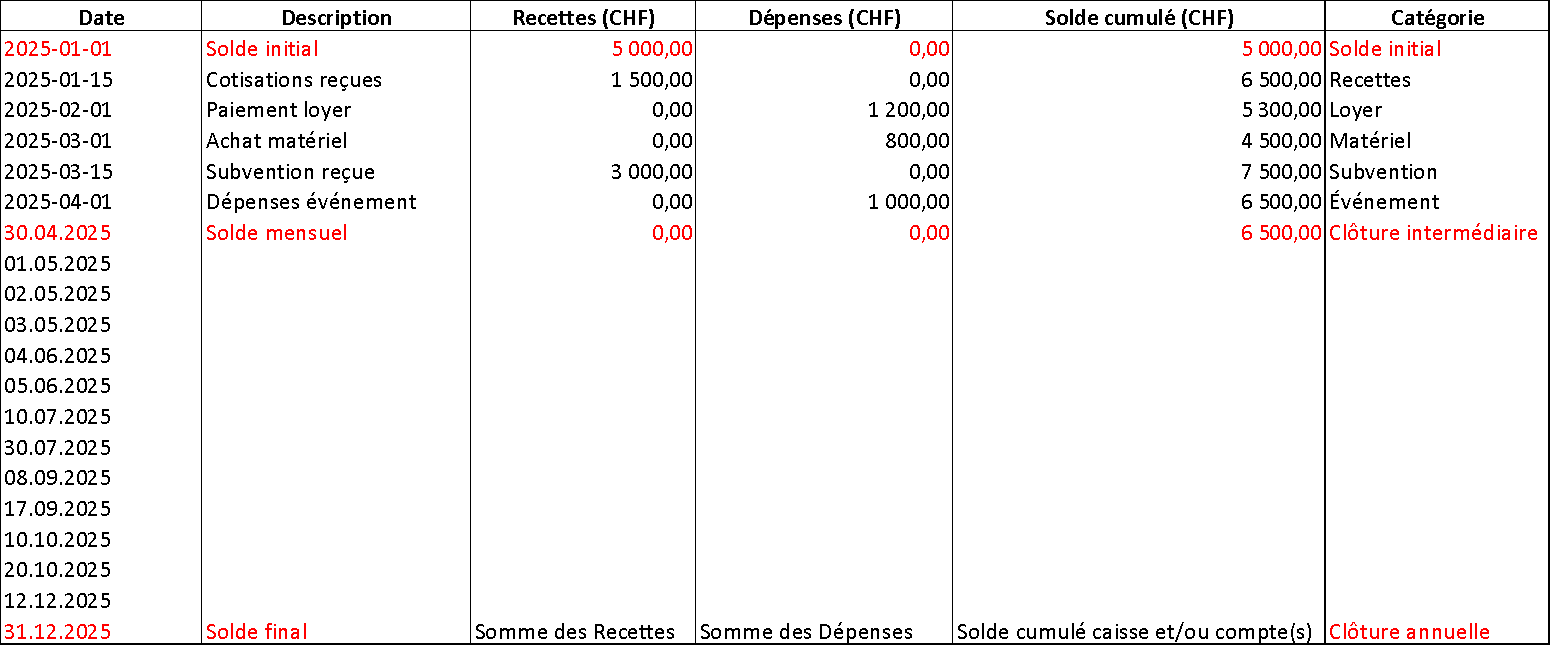
Details about the columns:
- Transaction dates – Indicate the date on which the cash receipt or disbursement actually took place (actual cash flow), not the date of the invoice or commitment.
- Description – Briefly describe what the revenue or expenditure corresponds to.
- Income and expenditure – Enter the amounts actually received or paid.
- Cumulative balance – Indicate the financial status after recording the income or expenditure.
- Category – Specify the main heading under which the income or expenditure is listed; this information will be used to calculate the total in the income and expenditure account.
Presentation of the income and expenditure account
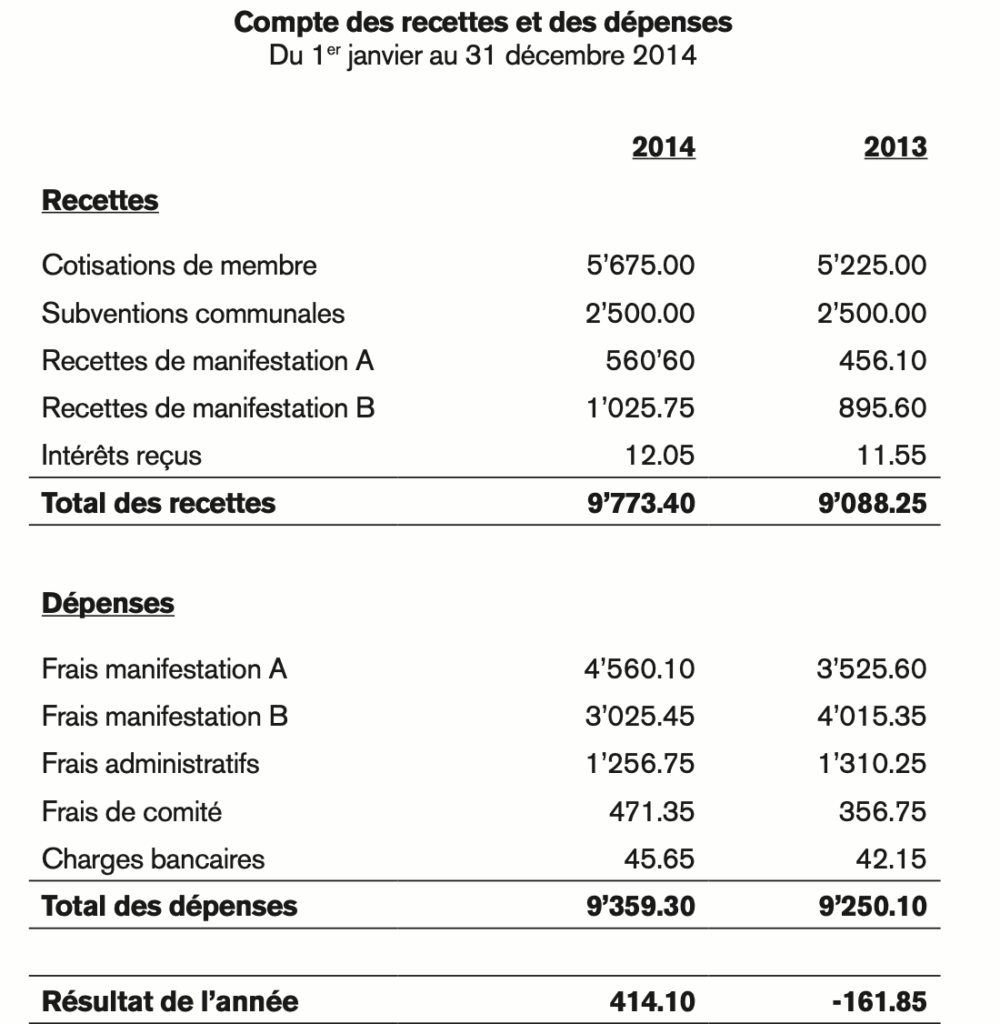
At the end of the financial year, for the purpose of preparing the annual accounts, income and expenditure are grouped and totalled by category (see above) to create the income and expenditure account. It is therefore not necessary to list the dates or details of individual transactions — only the main categories and the total for the financial year need to be shown. Below is an example of how an income and expenditure account is typically presented.
Financial position
As mentioned above, in cash accounting the second document required at the end of the financial year is the association’s statement of assets and liabilities. This essentially provides a snapshot of the association’s financial position at year-end.
You must therefore indicate the amounts held in cash and bank and/or postal accounts. Below is an example of a statement of assets:
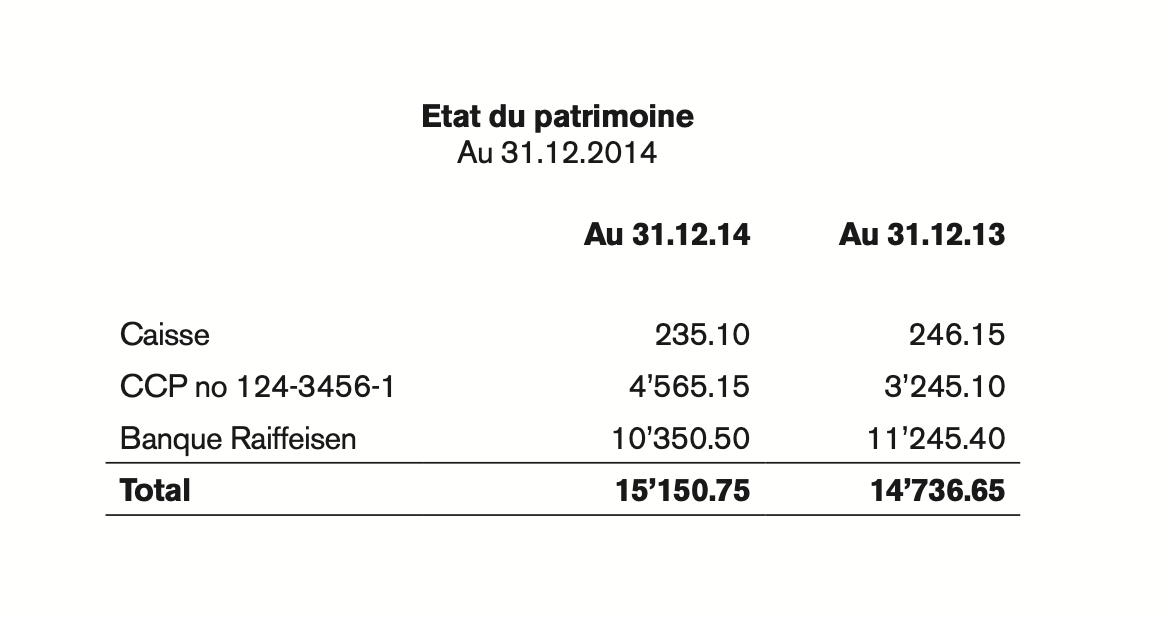
Please note: Make sure to include contingent liabilities (e.g., invoices received but not yet paid). Otherwise, the statement of assets and liabilities might show a positive balance at year-end, even if the association has outstanding expenses for several months. This would give a misleading view of its financial position and could jeopardise its long-term sustainability.
Amounts and/or balances must be carried forward to the chosen date (which will usually be the end date of the financial year). Generally, this is the 31st December of the current year.
However, an association may choose a different date if there is a valid justification. The financial year typically lasts 12 months, except for the first financial year, which may be shorter or longer (up to a maximum of 23 months). The closing date is generally specified in the association’s articles of association or determined by a decision of the general meeting or committee. Once established, the date should remain consistent to allow for meaningful comparison of financial years from one year to the next.
Once the financial year has ended, the annual accounts — prepared on a cash basis — are signed by those authorised to represent the association, typically the chairperson and the treasurer. This signature certifies that the accounts have been finalised, validated, and approved by the committee before being presented to the general meeting.
Once approved by the general meeting, the financial year is closed, the treasurer is formally discharged from their duties by the general meeting, and a new financial year begins.
The accounts must then be presented to the general meeting for approval, typically within three to six months of the financial year-end, unless otherwise specified in the articles of association.
If the association is small and does not engage in commercial activities, there is no legal requirement to have its accounts audited by a supervisory body. However, it is recommended that all associations, regardless of their size or activities, have their accounts audited by an independent party to ensure transparency and promote good governance.
La comptabilité commerciale (ou comptabilité en partie double)
The difference between the three accounting systems primarily lies in how transactions are recorded and presented in the accounts, and consequently in the financial statements.
Commercial accounting includes, in addition to cash flow, a balance sheet, an income statement, and, where necessary, notes to the accounts. Its purpose is to present the organisation’s financial position in a way that allows a third party to form a well-informed opinion.
It’s important to distinguish this type of accounting from simple cash flow monitoring (i.e., bank or cash balance). While cash flow only reflects actual receipts and payments, commercial accounting also takes into account invoices issued but not yet collected, as well as invoices received but not yet paid. As a result, it offers a more comprehensive view of the association’s financial position and its commitments.
Commercial accounting is therefore based on the double-entry principle, where each transaction is recorded twice – once as a debit and once as a credit – in two separate accounts, ensuring that the balance sheet always remains balanced.
The applicable standards and legal requirements are those of the Swiss Code of Obligations (CO) (Articles 958 to 962) and the Olico (Ordinance on the Keeping and Retention of Accounting Records)
Maintaining commercial accounts can be particularly challenging. For this reason, we recommend seeking the assistance of experienced individuals or professionals (e.g., qualified accountants) to set up the chart of accounts, configure the software, and even prepare the financial statements. To manage these accounts, it’s essential to use specialised software that automatically generates balance sheets and income statements from the accounting entries.
Given the complexity of commercial accounting, we recommend having it reviewed by an experienced accountant. While there is no legal requirement for official certification in Switzerland, the complexity of the accounts, legal obligations, or a desire for greater transparency may warrant the use of a qualified or certified professional (e.g., a fiduciary or an auditor certified by the AOA). Due to the cost involved, it’s advisable to issue a call for tenders. We also refer you to the considerations regarding ordinary or limited audits, which can serve as a form of review. If you choose to have your commercial accounts reviewed by non-professionals, it may be wise to have them first reviewed by professionals.
A detailed example of this type of accounting can be found in the document entitled « L’essentiel de la présentation des comptes pour les organisations à but non lucratif et les personnes physiques subventionnées ».
Balance sheet
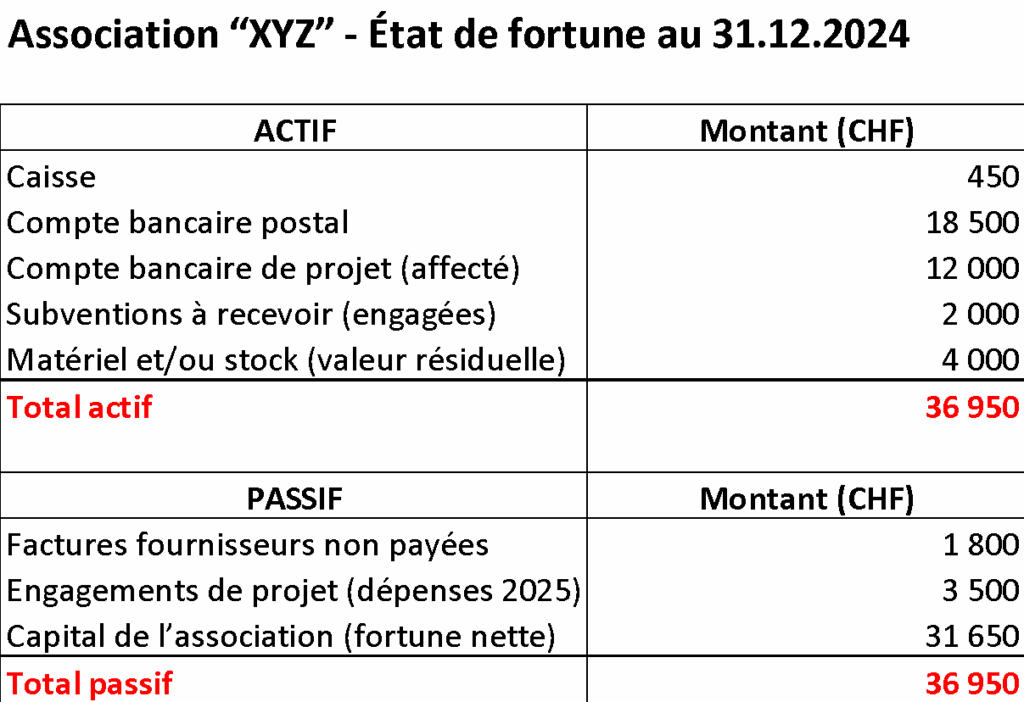
The balance sheet provides a snapshot of the association’s assets and financial position at the end of the financial year. It includes both the association’s assets and liabilities. Below is an example of what a typical balance sheet looks like.
Please refer to the glossary at the end of this page for explanations of the terms used in this table.
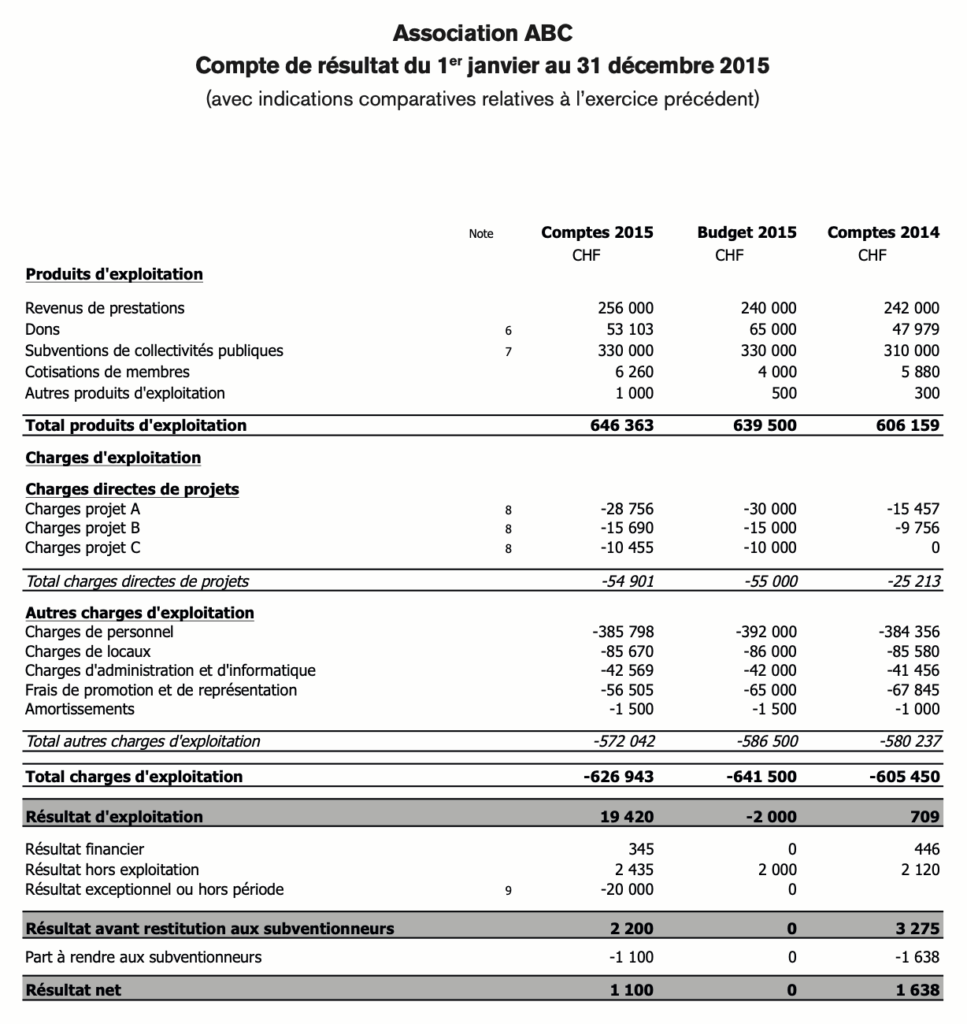
Profit and loss account (or income statement)
The income statement (also known as the profit and loss statement) reflects the association’s income and expenses during the financial year.
The notes to the accounts supplement and comment on the information provided in the accounts.
La comptabilité selon des normes reconnues
The main difference between the three accounting systems is how transactions are recorded and presented in the accounts, which in turn affects the financial statements.
Accounting carried out in accordance with a recognised standard follows the same basic principles as commercial accounting – it goes beyond simply monitoring cash flow (i.e., bank/post office and cash balances) to also include invoices issued but not yet collected, as well as invoices received but not yet paid. However, it takes things a step further, requiring greater transparency and detailed presentation, along with the recording of additional adjustments such as provisions, depreciation, and valuations. This approach enables the creation of financial statements that are both comparable and compliant with standards, offering a comprehensive view of the association’s financial position and commitments. However, it demands a higher level of accounting expertise and rigor.
For larger organisations, when an association controls one or more entities (a group), it may be required to prepare consolidated accounts (Art. 963 para. 4 CO). In this case, and provided it is subject to ordinary auditing (Art. 69b CC and 727 ff. CO), it must present its consolidated financial statements in accordance with an accounting standard recognised by the Federal Council (Art. 963a CO).
This is the most demanding type of accounting. Several standards apply, but the one best suited to the Swiss association model is Swiss GAAP FER (https://www.fer.ch/en/), published by Expert Suisse (formerly known as la Chambre fiduciaire) and recognised by the Federal Council.
RPC 21 specifically covers the preparation of accounts for non-profit organisations, outlining the basic principles to be followed, as well as the rules for presentation and allocation.
Given the complexity of this type of accounting, it is strongly recommended to consult a specialist fiduciary or an auditor certified by the FAOA.
In this type of accounting, the documents to be presented at the end of the financial year are as follows:
- Balance Sheet (RPC2)
- Income Statement (RPC3)
- Cash Flow Statement (RPC4)
- Notes to the Accounts (RPC8)
- Performance Report (recommended for charities)
- Report from the auditing body, if required by the CCS or CO (Article 69b of the CC, Article 727 of the CO)
Its purpose is to provide third parties with valuable information about an association’s assets, financial position, and performance in a structured format, through financial statements (the term used in Swiss GAAP FER to refer to the annual accounts formally approved by the general meeting).
For further information, see the document entitled ‘The essentials of financial reporting for non-profit organisations and subsidised individuals’ published by the City of Geneva. [add link]
Auditing and verification body
In Switzerland, the auditing of an association’s accounts can take three distinct forms, defined by federal regulations (Art. 69b of the Swiss Civil Code and Art. 727 et seq. of the Swiss Code of Obligations) and supplemented, in certain cantons such as Geneva, by specific provisions, particularly concerning thresholds of obligation and the possibilities for auditing by non-professionals. ( According to the documents Key points of financial reporting for non-profit organisations and subsidised individuals, and Appendix 1 of the Regulations governing the conditions for granting municipal subsidies (as at 1 August 2023)).
The different types of audit
Firstly, you need to determine what type of audit applies to your association:
If only one of the criteria for the higher level of audit applies to your association, then that is the regime you must apply.
| Type of audit | Criteria |
|---|---|
| Non-professional audit |
If subsidised by the City of Geneva:
|
Limited audit (727a CO) |
If subsidised by the City of Geneva:
|
Ordinary audit (727 CO) |
If subsidised by the City of Geneva:
|
Sélectionnez le régime auquel vous êtes soumis
Audit by non-professionals
In accordance with the Cross-cutting Directive on the Presentation and Review of Financial Statements of Subsidised Entities (EGE 02 04), Appendix 1 of the Regulations Governing the Conditions for the Granting of Municipal Subsidies (as at 1 August 2023) and Key Accounting Presentation Requirements for Non-Profit Organisations and Subsidised Individuals.
This type of audit involves entrusting the review of the association’s annual accounts to one or more individuals who are not certified auditors, but rather volunteers (often members of the association). They are known as verifier of the accounts. Given the relevant criteria, the majority of associations are subject to this regime.
Below, we explain how this type of audit should be planned and carried out.
How to conduct a non-professional audit
An association that is not subject to limited or ordinary auditing may choose to adopt accounting practices appropriate to its situation (cash or commercial accounting) and can voluntarily opt for an audit if it wishes.
The mandate, duration, and scope are determined by the articles of association or the annual general meeting.
Even if this audit is carried out by non-professionals (Persons who are not (expert) auditors approved by the AOA), the verifier of the accounts must be independent and competent, demonstrating a sound basic knowledge of accounting. They may be members of the association or trusted external individuals.
We recommend that verifier of the accounts has no personal interests in the organisation and no close connections (such as family or friends) with its management. To limit their liability, they should not oversee their own work. For the sake of independence, they should not be a member of the committee, board, or management, nor should they manage the accounts or be an employee of the organisation. Additionally, they should have no family relationships with the treasurer or accountant. However, they may be a general member of the association. It’s worth noting that some funders, such as the City of Geneva, require that there be no such ties. It’s always best to avoid potential conflicts of interest, as a verifier of the accounts with such a conflict may face their mistake being perceived as an intentional wrongdoing in the event of an error.
It is also recommended that two verifiers of the accounts be appointed to better ensure the independence of the audit and minimise the risk of any errors or inaccuracies.
It should be noted that, in such cases, no specific legal or professional standards apply to the verification of accounts, unless mandated by law under Article 69b of the Swiss Civil Code. Their work relies on trust and sound association practices. The City of Geneva provides a protocol in the document titled ‘The Essentials of Financial Reporting for Non-Profit Organisations and Subsidised Individuals’, which forms the basis for this chapter. It specifies, in particular, that the verifier of the accounts primarily checks:
- that the annual accounts accurately reflect the information in the records;
- that the accounts are maintained regularly;
- that the accounting rules and principles applicable to the organisation are adhered to;
- that the annual accounts are free from any anomalies or errors significant enough to mislead the reader regarding the organisation’s overall financial position;
- that legal requirements, particularly those relating to taxes and social security contributions, are being met.
- that the organisation is not in a situation of excessive debt or cessation of activity in the near future (1 year).
Following these checks, the verifier(s) of the accounts shall draw up a simple report (The points to be mentioned in such a report are listed in the ‘Essentials of Financial Reporting for Non-Profit Organisations and Subsidised Individuals’ on page 53) which is then submitted to the general meeting for approval or rejection of the accounts. If any issues are found, the verifier of the accounts may include a reservation in their report or even recommend that the general meeting reject the accounts.
If the accounts are not approved, then the committee must make the changes to the accounts requested by the general meeting and organise a new extraordinary general meeting in order to have them validated. Members may also decide to take action against the committee if they believe that it has mismanaged the association’s affairs.
If the verifier(s) of the accounts have doubts about the association’s ability to continue as a going concern (survival beyond one year) or about its excessive indebtedness, the assets and liabilities must be valued at their liquidation value (market value) and the potential cessation of activities must be indicated in the report submitted to the general meeting. Over-indebtedness is governed by Article 725a, b and c) of the Swiss Code of Obligations (CO).
If the verifier(s) of the accounts have doubts about the association’s ability to continue as a going concern (survival beyond one year) or about its excessive indebtedness, the assets and liabilities must be valued at their liquidation value (market value) and the potential cessation of activities must be indicated in the report submitted to the general meeting. Over-indebtedness is governed by Article 725a, b and c) of the Swiss Code of Obligations (CO).
While the establishment of an auditing body is only required for a small proportion of legal entities, it is advisable for every association to have its accounts audited periodically. As mentioned earlier, this is not a legal obligation for associations that do not meet the criteria set out in Article 69b of the Swiss Civil Code (CC), but it is considered good practice and contributes to the association’s proper functioning. An audit can also be beneficial when applying for funding or grants, as the presence of an auditing body demonstrates transparency and sound financial control within the association.
Contrôle restreint
A limited audit is conducted by an external auditor (e.g., a fiduciary), who acts as a certified auditor under the Federal Act on the Licensing and Oversight of Auditors (AOA). Te audit (limited or ordinary) must be carried out by a person or company registered in the public register maintained by the FAOA (Federal Audit Oversight Authority) pursuant to the AOA (Audit Oversight Act).
The auditor must comply with the approval rules set out in section 2 of the AOA. It is also essential to guarantee the independence of the auditing body (Article 729 of the CO).
Even if an association is legally required to undergo a limited audit, it may choose to have the audit conducted by non-professionals (opting out of the limited audit) if it has fewer than 10 full-time equivalents (FTEs) on average per year and with the unanimous agreement of the general meeting (Section 69b(3) of the CC).
Contrôle ordinaire
This type of audit must be conducted by an external auditing body (e.g. a fiduciary), acting as an expert auditor within the meaning of the Federal Act on the Licensing and Oversight of Auditors (AOA) (Article 727b of the CO). The auditor must comply with the approval rules set out in section 2 of the AOA. It is also essential to guarantee the independence of the auditing body (Article. 728 of the CO).
Glossary
Cliquez ici pour afficher le glossaire
Turnover: The total value of sales or services provided by an association or company over a specific period, before any deductions for expenses or costs. In other words, it represents the total amount invoiced to beneficiaries, customers, or partners.
Revenue and Expenditure (Income and Expenses)
Revenue: All amounts received by the association, including membership fees, donations and bequests, public grants, event revenue (such as ticket sales, refreshments, etc.), sales of goods or services (e.g. crafts, food products, cultural services, training), and financial income like interest.
Expenditure: All payments made by the association, including rent, utilities (e.g. electricity), insurance, equipment, supplies, fees and salaries, travel expenses, communications, reimbursements, and purchases of goods and services.
Assets
Transitory assets: Refers to prepaid expenses or accrued income that are recorded as assets on the balance sheet for the following period.
For example, rent paid in December for the month of January in the following year is recorded as a prepaid expense under assets.
Cash: Cash held at the end of the financial year.
Bank account(s) and/or postal account(s): Total balances (in CHF) at the end of the financial year.
Project bank account(s) (allocated): A separate account opened in the name of the association to manage the income and expenditure of a specific project, ensuring transparency and traceability. These funds, which come from restricted donations or grants, cannot be used for general expenses (such as rent, electricity, etc.).
Grants receivable: Donations and/or grants that have been officially promised but not yet received by the time of closing. These are considered receivables (ideally supported by a written and legally binding commitment).
Equipment: An inventory of physical assets and equipment owned by the association, of significant value and intended for long-term use (e.g. computers, furniture, stage lighting, costumes, tents).
Inventories: Consumable or resalable goods held temporarily (e.g. T-shirts, books, crafts, food products, school supplies). Their valuation must be prudent, documented and consistent from one year to the next.
Assessment methods
- Equipment: Estimated current value (or residual value) at the closing date.
- Inventories: Acquisition value (price paid) or probable realisable value, whichever is lower.
In both cases, estimate with prudence.
Liabilities
Transitory liabilities: Refers to income received in advance or expenses payable that relate to the current financial year but will only be invoiced or paid in the following financial year.
For example, fees for a service provided in December but not yet invoiced are recorded as income receivable (transitional liability).
Unpaid supplier invoices: Amounts owed to service providers or suppliers that haven’t been paid by the closing date. Even though these debts don’t show up in the cash flow statement, they must be listed in the balance sheet.
Project commitments (future expenditure): Planned and approved expenses (e.g. contracts signed by 31 December, funding already set aside), to be paid in the following financial year.
Net assets of the association
Definition: Net asset value of the association at the closing date.
Formula :
Net assets = Assets – Liabilities = What remains after all debts have been paid.
Typical composition of an association’s net assets (depending on the size and nature of the association):
- Starting capital/endowment fund
- Retained earnings (accumulation of previous results)
- Profit for the current financial year
- Earmarked funds
- Unrestricted funds (not earmarked for a specific use = allows the association some flexibility)
We recommend following this approach wherever possible, as it ensures the transparency needed for public subsidies, especially those from the City of Geneva. This is seen as ‘good practice in Geneva’.