
Table des matières
Introduction
The purpose of this guide is to assist those responsible for running an association in managing its tax affairs correctly.
Contrary to popular belief, an association is subject to taxation just like any other entity.
Whether your association is newly established or long-standing, it must comply with the relevant tax obligations.
It is therefore important to stress one key point: even if an association does not receive a tax return to complete, it is still required to pay any taxes due. In practice, there is no centralised register of associations, and the Cantonal Tax Authority (Administration fiscale cantonale – AFC) has no automatic way of knowing when a new association has been established.
It is therefore the responsibility of the committee to notify the AFC of the association’s creation so that it can receive a tax return and meet its tax obligations.
Only once the AFC has formally confirmed that the association is not liable for tax is it released from this requirement.
This framework is organised into three steps to support you in reviewing your association:
- 1st step: Knowing which taxes apply and to whom
- 2nd step: Ensuring that the association is fully compliant with the authorities
- 3rd step: Avoiding taxes wherever legitimately possible
We hope you find this guide helpful.
1st step: Knowing which taxes apply and to whom
Type of taxes
Firstly, it is important to know which taxes an association is subject to.
As a legal entity, an association is primarily required to pay the following federal and cantonal taxes:
- Income tax
- Capital tax
- Supplementary property tax
- Tax on property profits and gains
In addition, certain specific taxes apply both to the association as a legal entity and to third parties. These may include, for example, members of the association, donors, or individuals purchasing goods or services from the association. The relevant taxes are as follows:
- Value added tax (VAT)
- Tax on donations
Finally, we will outline the taxation of reimbursements that pertain solely to third parties but which may nevertheless affect the association’s activities.
Taxes that only apply to the association as a legal entity
Income tax
Tax on an association’s income is levied by both the Confederation and the county on the profits made by an association in a given year.
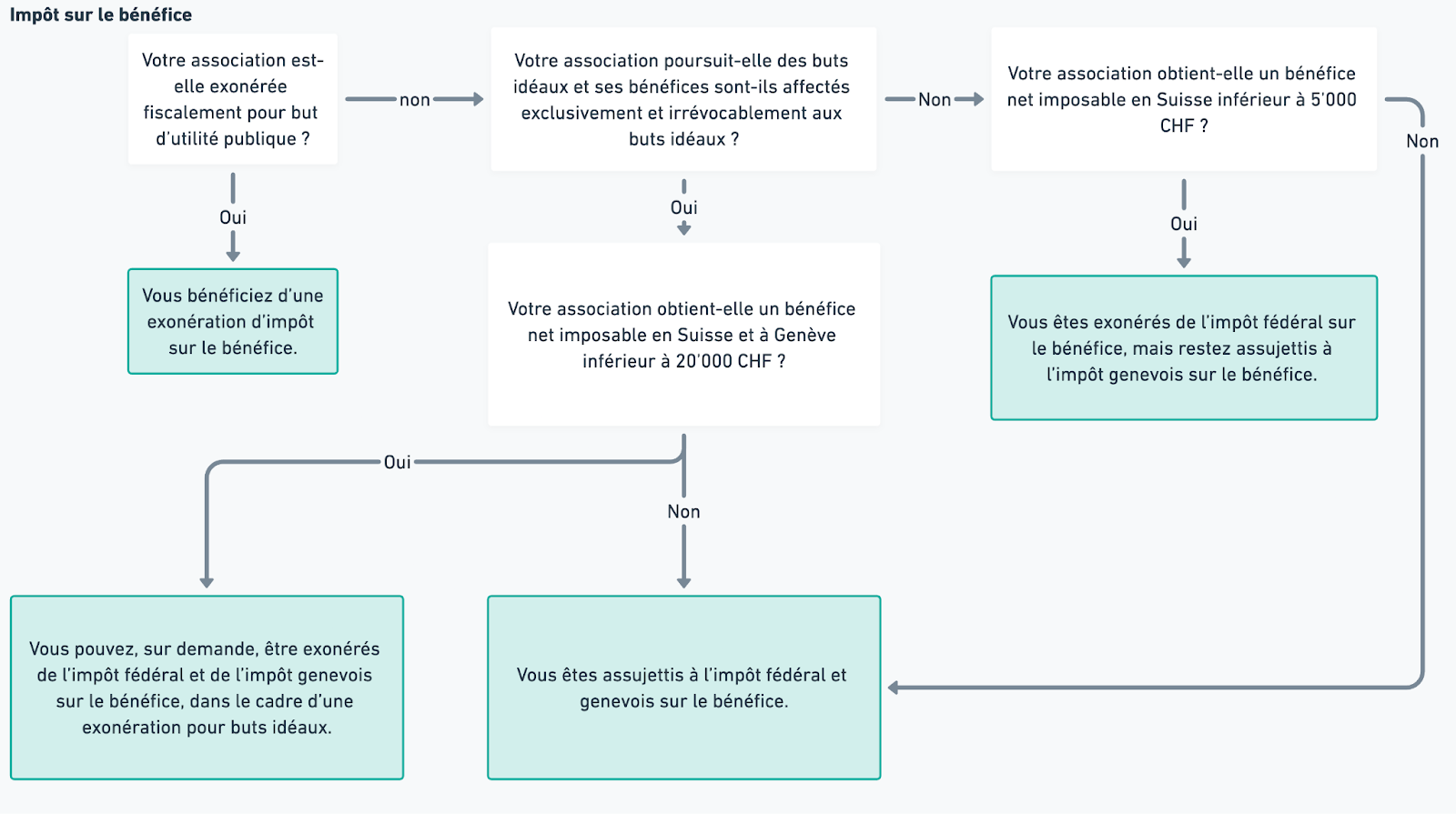
An association may be granted exemption in several ways, namely:
- If the association earns a taxable net profit in Switzerland of less than CHF 5,000, it is exempt from federal income tax (however, it will still have to pay Geneva income tax)1;
- If the association earns a taxable net profit in Switzerland and a total profit in the canton of Geneva of less than CHF 20,000, pursues idealistic goals and allocates its profits exclusively and irrevocably to those ideological goals, it is exempt, upon request, from federal and Geneva income tax2. (see step 3);
- If the association is exempt from tax for public benefit purposes (see step 3), then it will be exempt from federal and Geneva income tax3.
Diagramme pour l'impôt sur le bénéfice
Capital tax
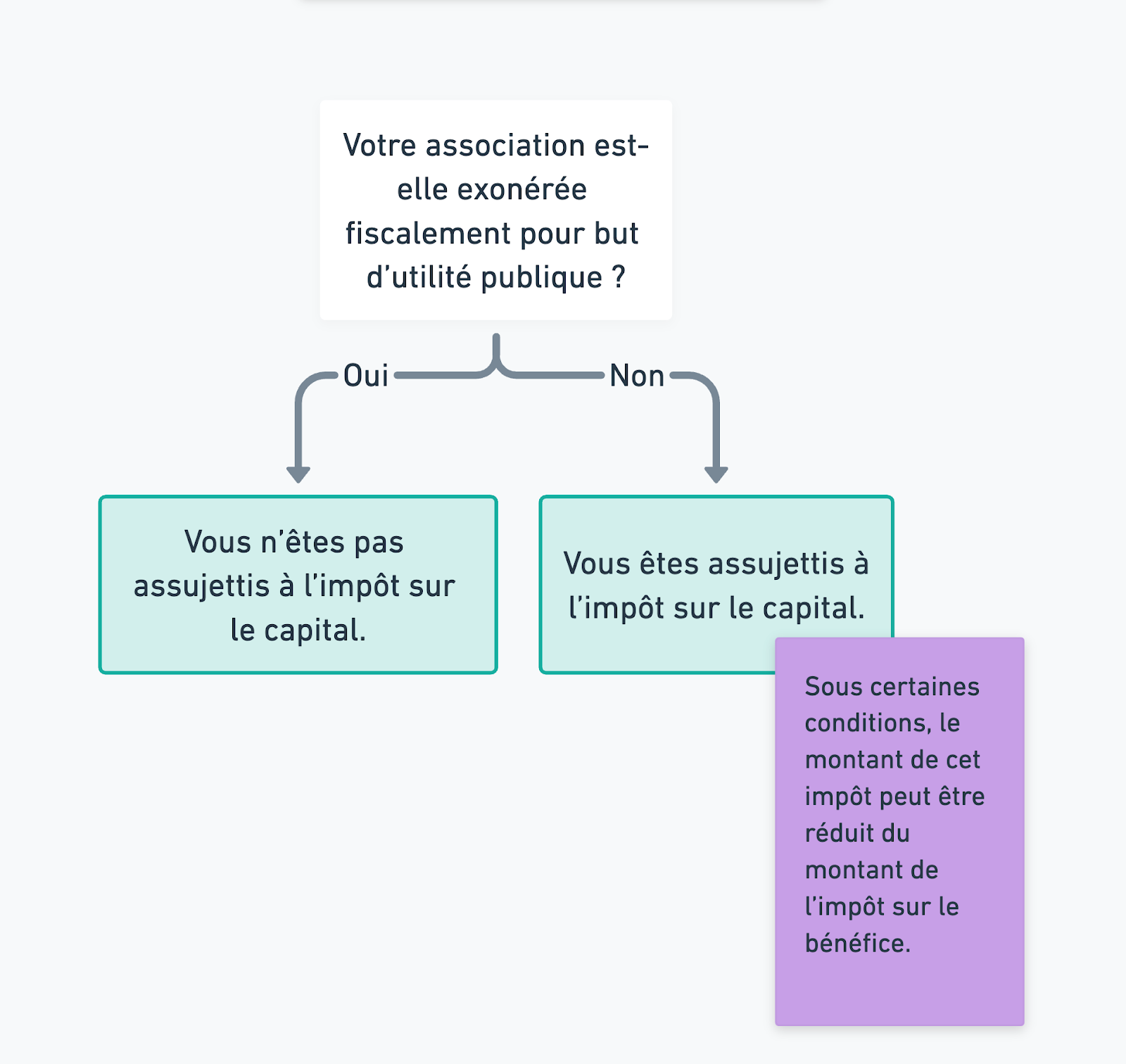
Capital tax is a tax specific to Geneva that is levied on the capital held by the association at the end of its financial year (tax period)4. Under certain conditions5, the amount of capital tax may be reduced by the income tax payable. The only way to obtain exemption from this tax is through recognition for public benefit purposes (see step 3)6.
Diagramme pour l'impôt sur le capital
Supplementary property tax, and tax on property profits and gains
These two taxes apply only to associations that own or have owned real estate during the past year. Please click the buttons below to view information relating to these taxes.
Supplementary property tax
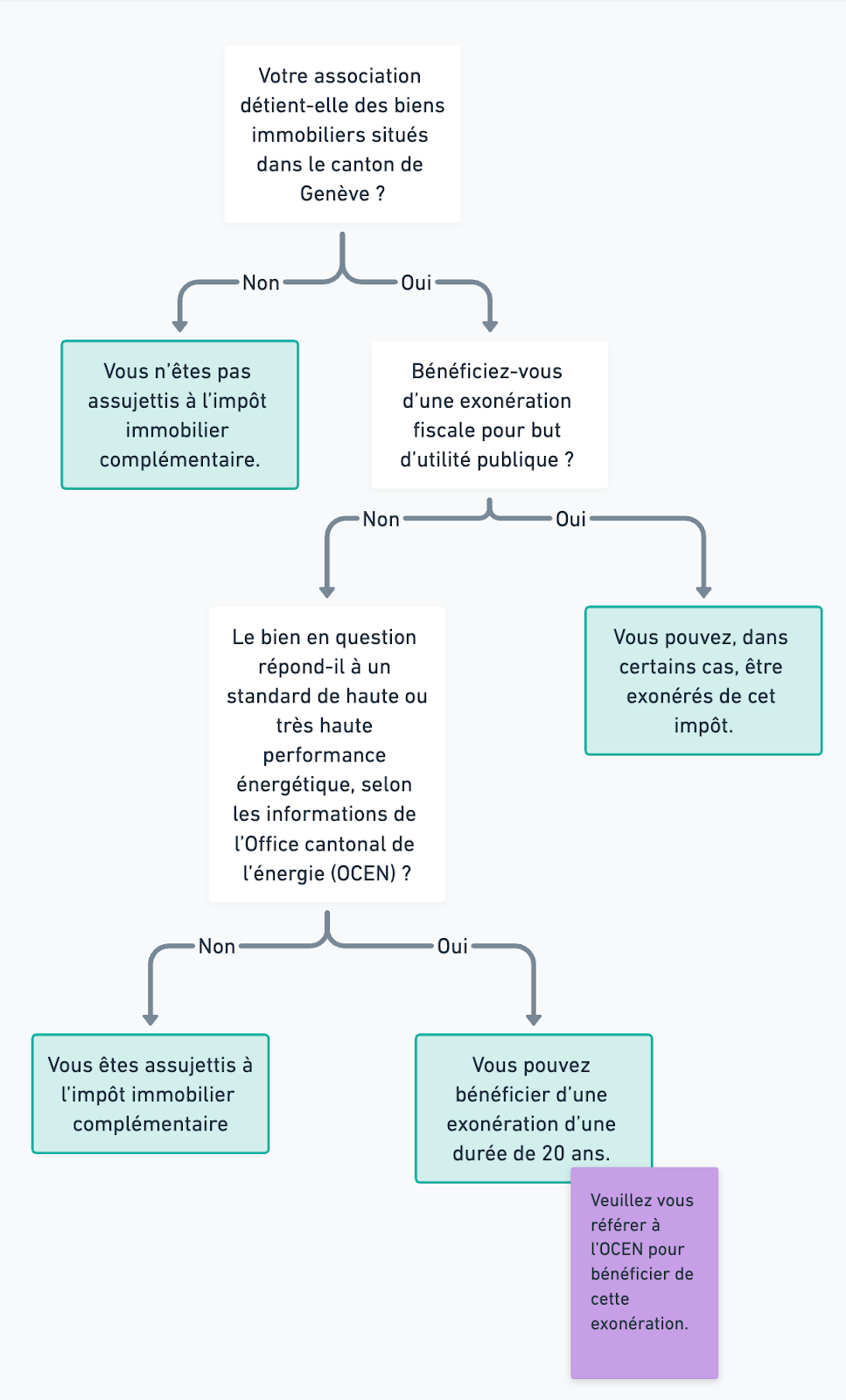
Supplementary property tax applies to all buildings in the canton of Geneva owned by the association. The tax rate ranges from 1% to 2% of the property’s taxable value. For information on the amount of tax applicable to your property, please consult the resources provided on the Canton of Geneva’s official website7.
The association may be exempt from this tax for a period of 20 years if the property in question meets a high or very high energy performance standard. For further details on this exemption, please consult the Cantonal Energy Office (Office cantonal de l’énergie – OCEN) after reviewing the information provided by the Canton8.
Furthermore, under certain conditions, recognition for public benefit purposes may also exempt the association from this tax9 (see step 3).
Diagramme pour l'impôt immobilier complémentaire
Tax on property profits and gains
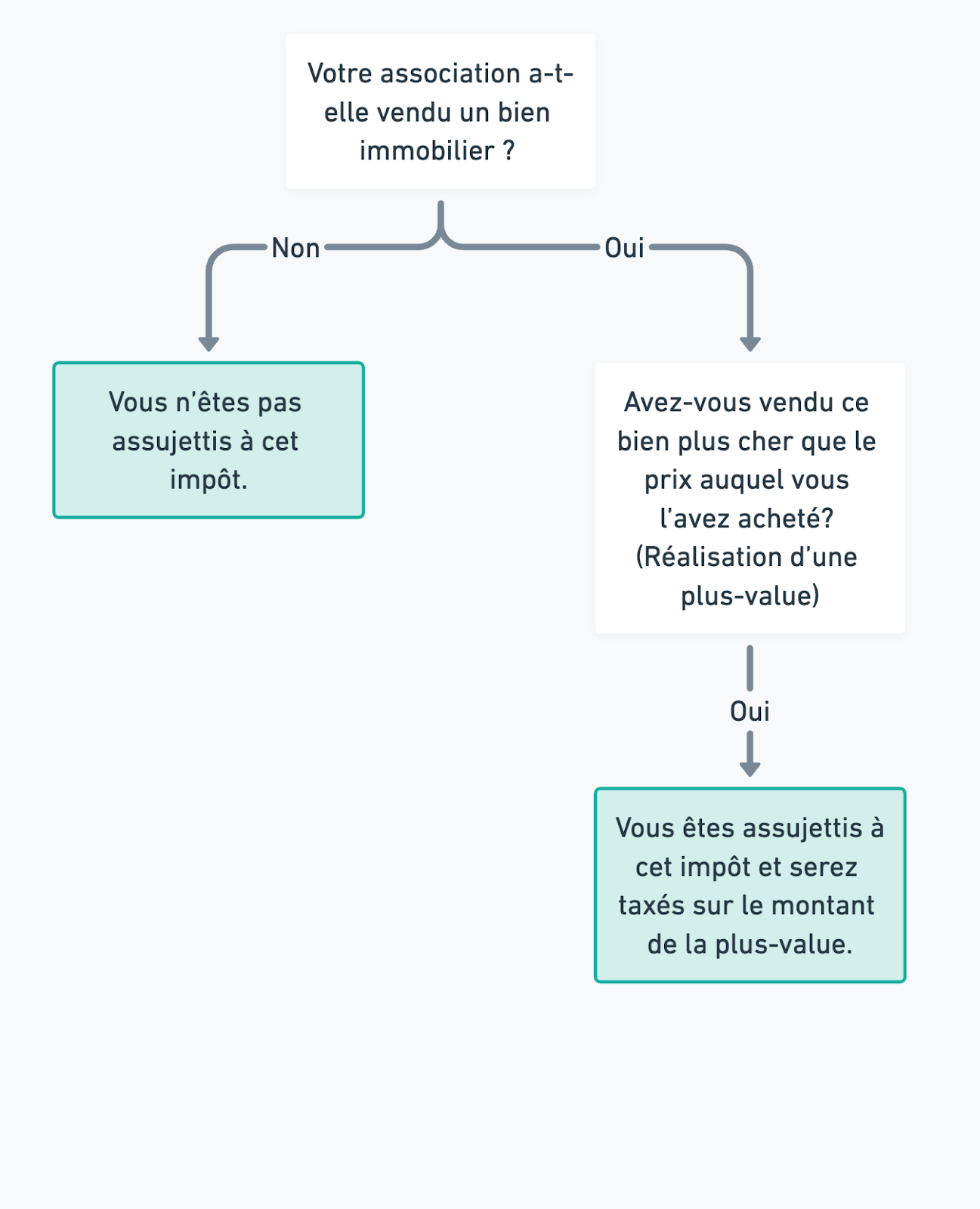
Tax on property profits and gains aims to tax capital gains made on property transactions10. For example, if your association sells a property in the canton of Geneva for more than its purchase price, any capital gain will be subject to tax.
The canton of Geneva provides a tool on its website for calculating tax on property profits and gains11.
Tax exemption for public benefit purposes does not exempt the association from paying tax on property profits and gains.
Diagramme pour l'impôt sur les bénéfices et gains immobiliers
Taxes that apply to the association and third parties
Value added tax (VAT):
As this is an indirect federal tax, you will not be charged VAT when submitting your tax return. The purpose of this tax is to apply to end consumers within Switzerland.
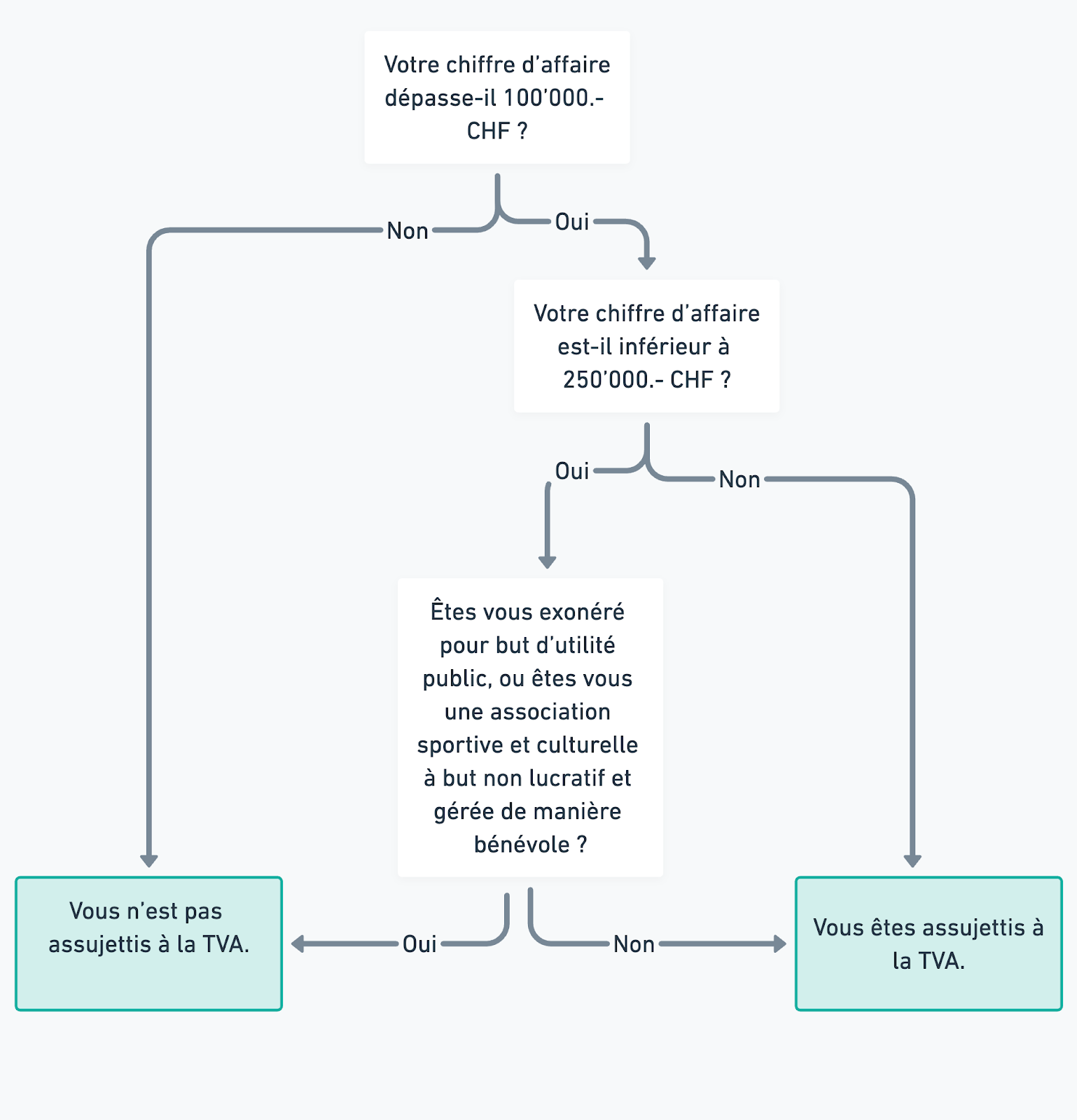
An association becomes liable for VAT once its turnover exceeds CHF 100,000. However, if the association’s turnover is below CHF 250,000, it is not subject to VAT in the following circumstances:
- The association is exempt for charitable purposes, or
- The association is a non-profit sports or cultural association managed on a voluntary basis12
When calculating turnover, certain services should be excluded, such as admission fees for cultural or sporting events and museums or other venues; registration and licence fees; services provided by public institutions to promote the image of third parties; and training services in the fields of music, art, or sport13.
VAT operates on a self-assessment basis. This means that as soon as the association meets the conditions for VAT liability, it must be registered with the Federal Tax Administration (Administration fédérale des contributions – AFC)14. If the association does not meet the conditions for liability, no action is required.
Tax exemption for public benefit purposes does not exempt the association from paying VAT.
In its dealings with third parties, if the association is liable for VAT, the third party must pay VAT on each service provided by the association on their behalf.
Diagramme pour la TVA
Tax on donations
Donations made to an association may have tax implications.
In terms of taxation on the association’s profits and taxation on the association’s capital, donations received from third parties have no impact15. This means that donations received will not be counted as taxable profits or taxable assets.
The association will not pay extra tax on donations received.
However, making a donation is, in itself, subject to tax. This is known as the registration fee tax16. Therefore, when one person makes a donation to another, tax must be paid to the AFC on that donation. The amount of tax depends on the circumstances, in particular the size of the donation and the relationship between the donor and the recipient.
For example, a father giving CHF 10,500 to his child will be taxed at a rate of 3% in registration fees17. This 3% rate is applied in particular because of the family relationship and the total amount of the gift.
However, in the case of a donation made by a third party to any association, the tax rate will be between 0 and 26%18.
The tax exemption for public benefit purposes (see step 3) allows the association to be exempt from registration fees19.
The tax exemption for public benefit purposes granted to an association also allows third-party donors to deduct donations made to the exempt association from their own taxes (see Step 3).
Taxes that only apply to third parties
Relationships between an association and third parties, such as its members, may have tax implications for those parties. This is particularly relevant when the association makes payments to a third party.
At this point, it is important to distinguish between expense reimbursements and remuneration, as this distinction has practical significance.
Expense reimbursements (or allowances) are costs incurred by volunteers of the association—whether or not they are committee members—in the course of carrying out their duties. These expenses may include, for example, the cost of meals during activities, the purchase of equipment, or train tickets required for the association’s activities. Reimbursing such expenses, in full or in part, should be standard practice in every association, as it allows volunteers to contribute to the development of the association without shouldering the financial burden of their voluntary work.
Remuneration covers anything beyond expense reimbursements. Whenever the association pays money to a volunteer or committee member and the payment is not classified as an expense reimbursement, it is considered remuneration. Examples include attendance fees, sports lessons provided for a flat fee, or a full-time salary for work as the association’s secretary. Depending on the circumstances, the relationship between the association and the volunteer or member may be classified as a mandate or even as employment. In most cases, it will be considered employment, which gives rise to specific legal and administrative obligations20.
Tax on allowances and remuneration
Expense reimbursements made by the association to third parties will have no tax implications for them21.
In effect, this is essentially a form of loan repayment. The third party provided the funds necessary for the association to carry out an activity, and the association is now repaying this advance.
In contrast, any remuneration paid by an association to third parties will be taxable for the recipient22, particularly from an income tax perspective.
PLEASE NOTE: In practice, it can be challenging to distinguish between reimbursement and remuneration. To help you clearly differentiate between the two and correctly classify payments made to third parties, it may be helpful to adopt a policy on expense reimbursements23. It is strongly recommended that you have your payment verified by the Cantonal Tax Administration (Administration fiscale cantonale – AFC)24. If you do not take this step, the AFC may decide to reclassify certain expense reimbursements as remuneration, meaning the amounts reclassified would become taxable.
Conclusion
It is essential to determine which taxes apply to your association based on its specific situation.
For instance, if your association does not own any real estate, it will not be subject to the supplementary property tax or the tax on property profits and gains.
Similarly, if your association’s turnover is below CHF 100,000—or CHF 250,000 for sports, cultural associations, or those benefiting from tax exemption for charitable purposes—it will not be liable for VAT.
In all cases, your association will be subject to income tax and capital tax. Additionally, your association will need to pay registration fees on donations received, and members of the association will be taxed on any remuneration they receive from the association as income.
Tax exemption for public benefit purposes will provide relief from income tax, capital tax, supplementary property tax, and registration fees on donations. Furthermore, donors will be able to deduct donations made to your association if it qualifies for public benefit tax exemption (see step 3).
2nd step: Ensuring that the association is fully compliant with the authorities
Tax return
A tax return is a document that must be submitted each year to allow the authorities to assess your association’s financial situation. From this, the authorities will calculate the amount of tax that your association is liable to pay.
It is essential that the declaration is honest, complete, and accurate. You can complete the declaration in writing or use the GeTax software to submit it online25. The declaration must be returned within the timeframe specified on the form26. You may request an extension of the deadline27.
The Canton of Geneva provides a detailed guide to help associations complete their tax returns28. If you have difficulty completing your tax return, you can contact the AFC. In addition, several trustees experienced in working with associations can assist you with the form. Finally, within the limits of our expertise, we remain at your disposal for any questions you may have regarding your tax return.
What should be done if the association has not paid its taxes in recent years?
What is the risk?
Firstly, from a tax perspective, the authorities may claim back any outstanding taxes from you29. The authorities can ask you for any unpaid taxes from the previous 10 years.
Secondly, this could also result in the association being held criminally liable30. And that’s where things get complicated. If your association has failed to pay its taxes in recent years, it could face criminal prosecution for ‘tax evasion’. This may result in a fine ranging from one-third to three times the amount of tax evaded, in addition to any outstanding tax owed.
If you would like an overview of the risks your association may face, the Canton of Geneva provides an Excel document to help calculate the tax amount31. With this tool, you can work out the tax your association should have paid for each year.
What should we do?
The association can make a voluntary disclosure to avoid criminal charges. This triggers a form of tax amnesty with the authorities. The conditions are as follows:
- The association must make a voluntary disclosure on its own initiative
- It must be the first time it has done so
- No tax authority must yet be aware of the situation
- The association must cooperate fully in establishing the assets and income that were not declared
- It must make every effort to pay the amount owed32
For further information on tax amnesty, please visit the Canton of Geneva website33.
The association will then have to pay the tax arrears, as well as future taxes.
Fortunately, as part of this regularisation process, the association can apply for retroactive tax exemption. However, it must have met all the conditions required for tax exemption throughout the entire regularisation period (see step 3).
Conclusion
To stay on the right side of the authorities, all you need to do is submit your association’s tax return accurately each year. Of course, nobody is perfect, and in a voluntary association, you may have overlooked this obligation for a few years.
Don’t panic! Simply contact the AFC and explain your situation. If you act promptly, you can avoid criminal proceedings, although you will still need to pay any outstanding taxes.
3rd step: Avoiding taxes wherever legitimately possible
All of the following information applies only to the Canton of Geneva. Tax authorities in other cantons may have different practices.
Introduction
The previous sections have outlined some of the forms of taxation that your association may be subject to. However, there is no need to be alarmed—being taxed is not inevitable. The State can, under certain circumstances, waive its right to levy taxes on your association. This is known as a tax exemption, which may be granted under specific legal conditions and for particular reasons.
In theory, tax exemption may be granted for a variety of reasons, such as public benefit, public service, or cultural purposes. In practice, however, associations are most commonly exempted on the grounds of public benefit; we will therefore focus on this type of exemption.
In this document, we will consider only tax exemptions granted for public benefit purposes. This type of exemption provides an opportunity to relieve the association of the majority of its tax obligations.
It is important to bear in mind that tax exemption is an exception rather than the rule. The conditions are strict, as the benefits are considerable, and the majority of associations will not qualify for this privilege. A careful review of the criteria outlined below will help you determine whether your association may be eligible for exemption (see ‘How do I know if I should apply for tax exemption?’).
It should be noted that tax exemption benefits associations recognised as being of public benefit, as donors often view it as a mark of good practice and sound organisation.
Moreover, obtaining tax exemption can provide access to free or discounted services from certain major providers.
What are the benefits of a tax exemption for my association?
For exempt associations, the exemption will cover federal and cantonal income tax, cantonal capital tax, supplementary property tax and registration fees levied on donations received. Tax on property profits and gains and VAT are not affected by the exemption (see step 1).
It should be noted that even if your association is exempt from tax, you are not exempt from the obligation to submit an annual tax return. You must therefore continue to file a duly completed return, accompanied by the relevant appendices, at the end of each tax period. In this return, you can indicate that the association is exempt on the grounds of public benefit.
For donors – whether individuals or legal entities, including other associations and companies – donations benefit from preferential tax treatment. This means that contributions made to an association exempt for public benefit purposes may be deducted from the association’s taxable net profit or the individual’s taxable net income, up to a maximum of 20% of the profit or income, respectively34. To qualify, the donation must be:
- In cash or another form of asset (voluntary time spent working for the association is not counted as a donation, nor are material goods)
- Useful to the association
- Worth at least CHF 10035
In order for donations to be tax-exempt, the association receiving them must provide the donor with a donation certificate. A sample certificate has been developed by the AFC36. This is an great way to thank donors for their contributions, as they will not be required to pay tax on these amounts. Please note, however, that membership fees are not considered donations and are therefore not tax-deductible37.
How do I know if I should apply for tax exemption?
It is important to bear in mind that tax exemption is the exception rather than the rule. The conditions are strict, as the benefits are considerable, and most associations will not qualify for this privilege. A careful review of the criteria outlined below will enable you to determine whether your association may be eligible for exemption.
General conditions
There are several cumulative conditions to be eligible for a tax exemption on grounds of public utility. All these conditions, both general and specific, will be detailed in this chapter.
The 7 conditions to be met in order to obtain a tax exemption on grounds of public utility are as follows:
General conditions:
- Not pursue profit-making objectives;
- Irrevocably dedicate its funds to the pursuit of its public benefit or public service objectives, with no possibility of returning them to the founders or donors; and;
- Effectively carry out an activity in Switzerland (no hoarding, i.e. not keeping money just for the sake of having it)
Specific conditions related to the general interest:
- Having a public interest objective;
- Having an open circle of beneficiaries
Specific conditions related to the principle of disinterestedness:
- Complying with the limits on expense reimbursements and remuneration of Committee members; and
- Not pursuing mutual assistance objectives.
The conditions in detail
1. Pursuit of non-profit objectives
A lucrative activity is an activity that generates income. To give a few examples, the following activities are lucrative: selling a book, giving lessons, running a bar, etc.
Please note that a lucrative activity and profit-making activity are not the same thing, and it is important to distinguish between the two. Not all lucrative activities necessarily indicate that the association is pursuing a profit-making objective38. For example, an association may decide to sell a book it has written without being considered by the AFC as pursuing a profit-making purpose.
However, the lucrative activity – in this example, the sale of books – must meet two conditions:
- It must not constitute the ultimate goal of the association; and
- It must remain subsidiary to the altruistic activity that forms the basis of its public utility status39
To assess whether the gainful activity fulfils the conditions – and is therefore secondary to the altruistic activity40 – the AFC pays particular attention to several criteria.
Firstly, ancillary activities must generally not account for more than 50% of the association’s income. If this threshold is exceeded, however, there are several ways to rectify the situation.
What to do if my ancillary activity exceeds 50% of my association's generated revenue
One way to address this is by seeking out new funders to secure grants, sponsorships, or donations. This will help reduce the proportion of resources derived from profit-making activities.
Another approach is to demonstrate that, even if your association’s profit-making activity appears to be predominant from an accounting perspective, this is not the case in practice. To support this, the AFC accepts a report detailing the number of hours of voluntary work carried out within your association. This can show that altruistic activity far exceeds profit-making activities in the day-to-day operations.
To do this, you should estimate the number of hours worked by the association’s volunteers on altruistic activities and compare them with the hours worked on profit-making activities. This comparison should clearly highlight that the association’s core mission is its altruistic work, which is funded by the resources raised through profit-making activities. This information can be included as an appendix to the association’s accounts.
Secondly, the association’s profits must be reinvested in its altruistic activities. The AFC will therefore review where the profits are reinvested, as this is another key indicator for the administration41. It must be demonstrated that the majority of the profits are reinvested in altruistic activities, which are fundamental to maintaining the association’s public utility status. The AFC aims to prevent all income generated through profit-making activities from being reinvested solely in those same activities. In such cases, it would be considered that the profit-making activity has assumed too prominent a role and is no longer serving the association’s altruistic objectives.
An increasing number of associations are adopting an innovative approach known as pay-what-you-feel pricing. Under this model, the association does not set a fixed price for the goods or services it offers; instead, it is up to the customer to decide how much to pay. The customer may choose to pay several times the market value or opt to contribute nothing at all. What makes this model particularly appealing for organisations practising pay-what-you-want pricing is that it is no longer regarded as a profit-making activity. In fact, the AFC classes payments made under this system as donations from third parties to the organisation.
2. Irrevocable allocation of funds to the pursuit of public benefit objectives
The association must irrevocably allocate its funds to the pursuit of its public interest purpose. This means that the funds must be used solely to achieve the association’s intended goals and cannot be diverted for any other purpose. In particular, the association cannot stipulate that these funds should revert to its founders or donors. An important detail is that this principle must be included in the articles of association. In practice, this may require an (extraordinary) general meeting to amend the articles before submitting the application to the AFC.
Example of a standard statutory clause
The following example is taken from the model statutes made available by Lyoxa. Feel free to download it at this link!
Art. X Liquidation
- (…)
- (…)
- The net assets shall be transferred to an association with a similar purpose or to a tax-exempt public utility institution designated by the General Assembly.
- Under no circumstances may the assets of the Association revert to the founding members or to any other member of the Association, nor be used for their benefit in whole or in part and in any manner whatsoever.
3. Effective activity in Switzerland
Carrying out an activity effectively in Switzerland means that the association must actively engage in its activities. The association cannot simply accumulate donations and grants in its bank accounts year after year without using them to further its intended purpose, as this could result in the failure to meet this requirement. Holding funds in a bank account for one or two financial periods is generally acceptable, but this should not be allowed to continue for an extended period. If reserves are being set aside for specific projects or unforeseen circumstances, it is advisable to mention this in the financial statement notes, so as to justify these reserves to the tax authorities and donors.
Additionally, the Committee must include at least one person who is either a resident of Switzerland or holds Swiss nationality. This requirement ensures that the association maintains a genuine connection with Switzerland.
Specific conditions for exemption for public benefit purposes
An association applying for tax exemption on the grounds of public benefit must, in addition to meeting the general conditions, also satisfy specific requirements relating to the public interest and its altruistic nature.
4. Having a public interest objective
Firstly, the association must pursue a goal of broad public interest that benefits the community as a whole42. The administration largely bases its decisions on the general views of the population. For example, activities that are charitable, humanitarian, health-related, ecological, scientific, social, educational, or cultural in nature may be considered to serve the public interest. In short, the association’s purpose must be deemed sufficiently valuable by the Canton. The situation is assessed on a case-by-case basis.
For cultural associations
As for cultural associations, the events they organise must be open to everyone43. The following types of productions are generally recognised as being of public interest: those that promote high artistic standards and are accessible to a wide audience, those with an educational focus, or those that serve the common good. Associations whose aim is to support artists in need of assistance in a non-profit manner, or to foster cultural exchange with international artists, may also be considered of public interest. However, events that are purely for entertainment purposes, even if open to a broad audience, are not deemed to be of public interest (e.g. cinemas).
For associations based in Switzerland but operating abroad
For associations based in Switzerland but operating abroad, Switzerland’s commitment to international solidarity is considered a value worthy of support in terms of its public interest purpose. Close attention must be given to the specific requirements set by the AFC for monitoring the activities of these associations44.
It should be noted that promoting access to goods or services, in itself, is not recognised as a public interest goal by the AFC. Therefore, an association whose purpose is to provide low-cost services, even essential ones, will not be deemed to have a public interest purpose unless its services are almost free. The AFC is obligated to maintain competition and ensure that associations do not gain an unfair advantage over other market participants, even if the latter are not pursuing charitable objectives.
5. Have an open circle of beneficiaries
Secondly, the circle of beneficiaries must be open. This means that the association’s goals should not benefit only a small group of people, such as its members, individuals in a specific profession, or a family circle. In principle, the entire population should be able to benefit from the association’s activities in some way, without the need to become a member. Moreover, under no circumstances should only the members be the beneficiaries.
Some associations may have a limited circle of beneficiaries45. This circle may be limited by the nature of the activity, such as when the aim is to support a population that faces discrimination and/or social inequalities. In these cases, it is the responsibility of the association to justify this choice and demonstrate that the targeted approach serves the public interest.
Altruism
Finally, the association must act in an altruistic manner; that is to say, it must sacrifice itself for the benefit of third parties in the interest of the community46. To do so, the association must be particularly wary of:
- The reimbursement of expenses and remuneration of Committee members, and
- The absence of mutual assistance objectives.
6. Altruism of Commitee members
General principle
Committee members must act in an altruistic manner in the performance of their duties. In other words, they should serve on the Committee solely because they share the values and mission of the association, without ever expecting any personal gain, such as remuneration, in return.
If this is not the case, for example, when a committee member’s goal is to make the activity a source of income, the association will no longer be eligible for tax exemption.
Reimbursement of expenses (ordinary activity)
However, in certain cases, financial transfers between the association and committee members are permitted.
Firstly, committee members may, depending on the circumstances, be reimbursed for their expenses47.
To do this, a distinction must be made between Committee members performing ordinary duties and members performing extraordinary duties48.
Ordinary activities encompass all tasks that fall within the typical scope of a committee member’s duties (i.e., administrative and representative responsibilities, both internally and externally).
Possible compensation (extraordinary activity)
When the activity goes beyond the usual scope of the role, either due to an excessive workload or the need for specific skills that are not typically required to manage an association, it is considered an extraordinary activity.
To make this distinction, the tax authorities will assess factors such as the nature of the task, the size of the organisation, the complexity of the work, and the need for specific skills to determine whether the activity qualifies as extraordinary.
When a committee member is performing ordinary duties, they may only request reimbursement of their actual expenses (see step 1). The distribution of attendance fees is also permitted if it is done in accordance with the rules established by the Regulations on Official Commissions49.
However, if a committee member undertakes extraordinary work, they may be entitled to the benefits mentioned above (reimbursement of actual expenses, attendance fees) as well as appropriate compensation. This compensation may be set at market rates. However, careful attention must be given to the regularity of such compensation. If extraordinary activities become regular, it is advisable to transition to an employment or mandate contract.
Cases of contractual arrangement (employment or mandate)
A committee member may therefore be remunerated under an employment contract or a mandate contract. However, committee members who are employees or mandate holders shall only have an advisory role within the Committee and shall not have decision-making power. Additionally, the association must ensure that the contract is awarded in the best interests of the institution, rather than those of the employee or mandate holder50. However, hiring a committee member is difficult to implement in practice and is rarely compatible with an application for tax exemption or tax-exempt status. This measure should therefore only be considered as a last resort.
Remuneration that is incompatible with the rules set out above includes, in particular::
- Fixed compensation for Committee members when it exceeds the actual costs incurred;
- Fees paid according to the members’ sectors of activity for preparing for and participating in Committee meetings;
- Compensation for specific services without proof of work performed51
When providing appropriate compensation for extraordinary activities or employing a committee member, the association is strongly advised to send the specifications and any other relevant information to the AFC to ensure that the process complies with legal requirements and is compatible with tax-exempt status.
To demonstrate the altruism of the Committee members, it is essential to have such a clause in the association’s statutes.
Example of a standard statutory clause
The following example is taken from the model statutes made available by Lyoxa. Feel free to download it at this link!
Standard clause:
“1. Members of the Association’s Committee act on a voluntary basis and are only entitled to reimbursement of their actual expenses and travel costs. Any attendance fees may not exceed those paid for official commissions. For tasks that exceed the usual scope of the role, each member may receive appropriate compensation.
- Paid employees of the institution may only sit on the Association’s Committee in an advisory capacity.”
7. Absence of mutual assistance objectives
A mutual assistance objective exists when the association aims to promote the interests of its members, whether personal, scientific, or economic. This includes organisations such as sports and chess clubs, student associations, music societies, recreational clubs, and groups of people sharing the same hobby, etc52. Therefore, as soon as the articles of association mention a purpose like the one described above, the association will be automatically excluded from the scope of tax exemption for public benefit purposes. This is yet another reason to exercise particular care when drafting the association’s objectives.
Example of mutual assistance objectives:
“To protect and defend the image, rights and interests of members within the scope of their duties, vis-à-vis all third parties, and in particular all administrative or judicial authorities, in the course of their profession.“
Specific fields
The administration has provided further details on specific fields in which associations may operate. For more information on the area that interests you, we encourage you to refer to the following documents:
Click here to view the specific areas
CSI 202653:
- Music festivals, open-air concerts and similar events (p. 34),
- Monument conservation/landscape protection (p. 35).
- Private schools (p. 2)
- Care homes for the elderly, boarding houses and nursing homes (p. 5),
- Out-of-home care facilities for children (p. 8),
- Charitable organisations operating abroad (p. 10),
- Fair organisers and exhibitors (p. 22),
- Institutions active in the field of youth (p. 24).
How do I apply?
To apply for tax exemption for public benefit purposes, the association must complete the form available on the Canton of Geneva website54. The form is clear and easy to complete.
The approach to take when completing this form and when contacting the AFC is one of transparency and accuracy. The information provided must reflect the truth. If you are unsure about the accuracy of any detail, be sure to state this clearly on the form or inform your contact at the AFC. The more transparent you are in your responses, the quicker your request will be processed.
The AFC will use all available means to verify that the association meets the required conditions (see ‘How do I know if I should apply for tax exemption?’). In particular, it may consult any publicly accessible sources, including social media, websites, activity reports, the media, etc.
If your situation could lead to confusion and you have documents that demonstrate you meet the conditions, please include them with your application. It is the responsibility of the association seeking tax exemption to provide evidence that it fulfils the strict conditions set by the legislator55. It’s therefore up to you to be proactive.
What does the AFC do once my application has been received?
At the end of the process, the AFC will issue a decision in the form of a letter sent to your association’s headquarters. This letter will inform you whether your application for tax exemption for public benefit purposes has been granted, and if so, from which date. If you disagree with the decision and wish to appeal, you have 30 days from the receipt of the letter to do so. It is therefore important to check your post regularly to make sure you don’t miss this letter and the deadline for appeal in the event of a negative outcome.
How long does my exemption last?
Please note that, contrary to what is stated on page 10 of the guide published by the AFC, the authorities now tend to grant tax exemptions for a limited period, such as five years56. If this applies to your association, you will need to submit a new application for exemption at the end of the period to secure a renewal. We recommend that you anticipate this step by submitting your application a few months before the end of the stated period, to ensure you do not experience a gap during which you are not exempt, and therefore liable to pay the relevant taxes (IFD and ICC).
Can it be revoked?
Yes, it can. The AFC reserves the right to revoke tax exemption for charitable purposes at any time. This means your association must continuously meet the conditions for tax exemption. It is crucial that you remain vigilant and inform the AFC of any changes that might affect your eligibility for tax exemption for public benefit purposes (e.g. significant amendments to the articles of association, payment of remuneration to a committee member, etc.), especially if you intend to undertake an economic activity that was not included in your original application for tax exemption. Transparency and clarity in your explanations are always essential.
Is there anything else to be aware of?
Partial exemption
In theory, if the association’s funds cannot be devoted exclusively and irrevocably to the public benefit purpose, the association may be granted a partial exemption57. This entails significant accounting requirements, in particular the maintenance of separate accounts for the two activities. The various requirements for both the association and the donor are set out in a document published by the Swiss Tax Conference (Conférence suisse des impôts)58. The purpose of these formalities is to ensure that the funds granted exemption are actually used to support the public benefit purpose. In practice, the AFC rarely grants partial exemptions to an association. Instead, it typically recommends establishing two separate associations, rather than dealing with the complex accounting requirements.
Exemption for idealistic purposes
When an association does not qualify for tax exemption for public benefit purposes, whether total or partial, it may choose to apply for exemption for idealistic purposes. An idealistic purpose is not precisely defined by law59.
To give you an idea, the activities carried out by political, religious, scientific, artistic, charitable, recreational, or other associations that do not pursue an economic purpose are considered idealistic goals. The key point to remember is that this is a broad category, and many associations fall under it. This exemption allows associations with an annual profit of less than CHF 20,000 to be exempt from both federal and Geneva profit tax60. If you meet the requirements, contact the AFC directly, and they will provide you with the necessary information to proceed with the process.
Conclusion
The seven conditions that must be met to obtain tax exemption for public benefit purposes are as follows:
- Do not pursue lucrative goals;
- Irrevocably allocate funds to the pursuit of its public benefit purpose, with no possibility of return to the founders or donors;
- Effectively carry out an activity in Switzerland;
- Have a public interest objective;
- Have an open circle of beneficiaries;
- Comply with the limits on expense reimbursements and remuneration for Committee members; and
- Do not pursue mutual assistance goals.
When submitting your application, you will be responsible for demonstrating that you meet each of these conditions. If your association does not explicitly and strictly meet all of the required criteria but falls into a grey area, it will be up to you to use all available means to explain your situation and show that all conditions are met. For example, you could provide additional clarification in the notes to the accounts or contact the authorities directly.
Keep in mind that exemption is an exception to the usual tax regime for associations. Few associations meet the stringent conditions set by the authorities. While the benefits are appealing, do not waste your time applying for exemption if your association clearly does not fall within the established framework.
Bibliography
Click here to display the sources used in the drafting of this guide
- Administration fédérale des Contributions, Circulaire N°12 : exonération de l’impôt pour les personnes morales poursuivant des buts de service public ou de pure utilité publique (art. 56, let. g LIFD) ou des buts cultuels (art. 56, let. h LIFD) ; déductibilité des versements bénévoles (art. 33, 1er al., let. i et art. 59, let. c LIFD), juillet 1994, Bern, https://www.ge.ch/document/694/telecharger (dernière consultation : 17.02.25) (noté : circulaire 12) ;
- Conférence Suisse des Impôts, informations pratiques à l’intention des administrations Cantonales : exonération des institutions poursuivant des buts culturels, août 2010, Delémont, Genève, https://www.ge.ch/document/697/annexe/0 (dernière consultation : 17.02.25) (noté : CSI culture 2010) ;
- Conférence Suisse des Impôts, informations pratiques à l’intention des administrations Cantonales : exonération fiscale des personnes morales qui poursuivent des buts de service public, d’utilité publique ou des buts cultuels, janvier 2008, https://www.ge.ch/document/698/telecharger (dernière consultation : 17.02.25) (noté : CSI 2008) ;
- Conférence Suisse des Impôts, informations pratiques à l’intention des administrations Cantonales : Exposé sur l’exonération, plus particulièrement la déductibilité de dons bénévoles et la réserve de modification du but, en relation avec le droit des fondations révisé, août 2010, Aarau, Bern, Zurich, Genève, https://www.ge.ch/document/699/telecharger (dernière consultation : 18.12.24) (noté : CSI déductibilité 2010) ;
- Conférence Suisse des Impôts, Règlement-Modèle de règlement des remboursements de frais pour les entreprises et les organisations à but non lucratif, février 2024 https://www.ssk-csi.ch/fileadmin/dokumente/Spesen/Spesenreglement_Nonprofit_2024_FR.pdf (dernière consultation : 17.02.25) (noté : CSI Remboursement de frais) ;
- AFC, Demandes d’exonération fiscales : procédures et conditions à remplir, juillet 2021, https://www.ge.ch/document/610/telecharger (dernière consultation : 17.02.25). (Noté : Guide AFC) ;
- Wynne Julie/H. O. Gilliéron Hubert Orso, L’association, Genève, Zurich (Schultess) 2023 (noté : Wynne/Gilliéron) ;
- Neri-Castracane Giulia/Andrade Sara, Structuration juridique de la philanthropie, in Jusletter, 14 octobre 2024 ;
- Message concernant la loi fédérale sur l’exonération des personnes morales poursuivant des buts idéaux, 6 juin 2014, FF 2014 p. 5219 ss ;
- Noël Yves/Aubry Girardin Florence (édit.), Commentaire romand, Impôt fédéral direct, 2e éd., Bâle (Helbing Lichtenhahn) 2017 (cité : CR LIFD-Auteure) ;
- OCEN, Directive relative à l’attestation de haute (HPE) et de très haute (THPE) performance énergétique, novembre 2019, Genève (noté : OCEN) ;
- Projet de loi modifiant la loi sur l’imposition des personnes physiques (LIPP) (D 3 08), PL 12996 (noté : PL12996) ;
- République et Canton de Genève, Guide fiscal PM 2024 pour les associations et fondations, 2024, Genève, https://www.ge.ch/document/guide-fiscal-pm-2024-associations-fondations (dernière consultation : 17.02.25) (noté : Guide PM 24) ;
- Ville de Genève, L’essentiel de la présentation des comptes pour les organisations à but non lucratif et les personnes physiques subventionnées, août 2016 (noté : Ville de Genève) ;
- Oberson Xavier, Droit fiscal suisse, 5e éd., Bâle (Helbing Lichtenhahn) 2021.